Maha Sakthi Thunai
Shambhala Yantra Dhyan Lokam
Maha Sakthi Thunai
Introduction
Our Shambhala Yantra Lokam is beyond religious divisions. People of all religions come here, transcending religious boundaries, to receive divine grace. As stated earlier, God is One; Mahasakthi appears in whatever form we conceive or believe Him to be.
Why the Shambhala Yantra Lokam Was Established Here
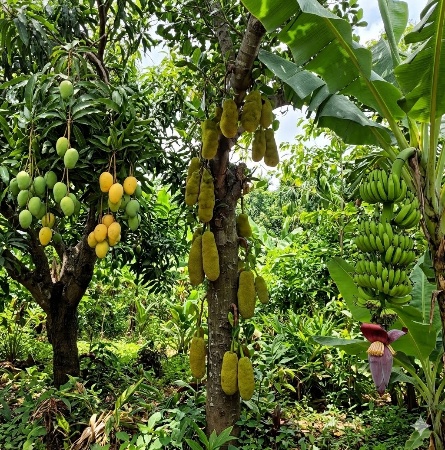
According to what the Guru’s Guru said Mahasakthi had revealed: “I will be present where the three fruits come together”—that is, where the mango, jackfruit, and banana trees are found together. They searched many places without success, but finally found that all three trees were present at this location. For many hundreds of years, Muneeswarar has also been worshipped here. The water at this place is excellent, and the Jeeva Samadhi of Sivavakkiyar is also located here. This is why our Shambhala Yantra Lokam is now established at this place.
Mahasakthi / Ekan

He is Mahasakthi (Ekan). Guruji saw Him only from behind; therefore, the statue of Mahasakthi in our Yantra temple is also positioned with a rear-facing form.
The subtle meaning behind this is that Mahasakthi gave the divine message: “Whatever you think of Me as, I appear to you in that form.” To express this truth, a statue representing Mahasakthi in a rear-facing form has been created here.
Special Features
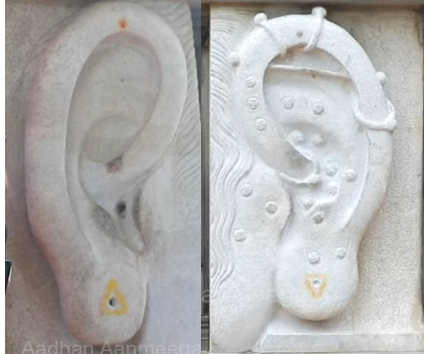
At our Shambhala Yantra Lokam, two ears resembling the structure of human ears have been consecrated. One is the Surya Nadi (Siva—male energy), and the other is the Chandra Nadi (Sakthi—female energy). Women may place their requests at the Surya Nadi, while men may place their requests at the Chandra Nadi.
The special feature is that the vibrations of the requests we speak travel through the openings in these ear-like structures and, through the Shambhala Yantra, merge with universal energy. Through this, our righteous requests are fulfilled by the grace of Mahasakthi. As Guruji always says, after expressing our requests here, when we say, “I am happy, I am joyful, I am healthy,” those positive thoughts merge with universal energy and benefit both us and everyone around us.
Shambhala Trikona Yantra
The design of our Yantra Dhyan Lokam is triangular (the sacred triangle mentioned in the Thirumandiram and associated with the chest of Thirumal). It is also called the Shambhala Trikona Yantra. Another special feature is that it transcends religious boundaries. People of all religions may meditate here without discrimination and receive the grace of Mahasakthi.
Religious Inclusiveness
Our Shambhala Yantra Lokam is beyond religious divisions. People of all religions come here, transcending religious boundaries, to receive divine grace.
This is a wonderful truth: Who is God? Is He Hari, Siva, the Lord, or Allah? As stated in the Thirumandiram, God is One—“Ekan”—yet He appears in many forms.
Rudraksha Tree
At our Dhyan Lokam, a Rudraksha tree planted by Guruji’s sacred hands gives us three-faced Rudrakshas every year. The special feature is that when Guruji bought this tree, he was told that it would bear nine-faced Rudrakshas. However, today the tree gives us three-faced Rudrakshas. This once again reminds us of the power of the triangle.
Kutham & Kuyam Gates
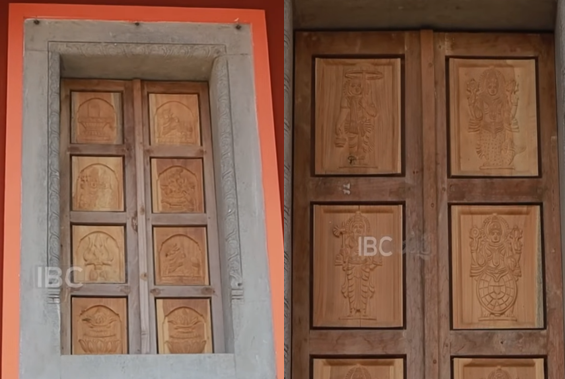
There are two gateways at our Dhyan Lokam. One is the Kutham Gate (Kailaya Gate), and the other is the Kuyam Gate (Heavenly Gate). The Kutham Gate is opened at our Dhyan Lokam on every Maha Shivaratri, and the Kuyam Gate is opened on every Vaikunta Ekadashi.
Sri Lakshmi Kubera Sai Nathar
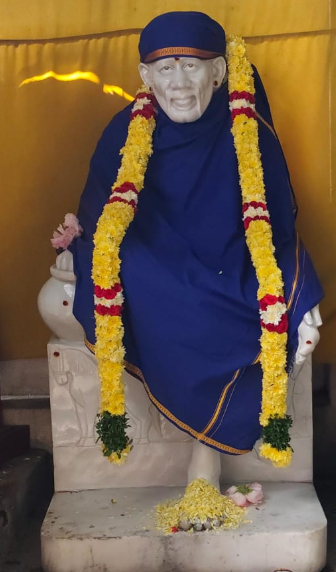
At our Shambhala Yantra Dhyan Lokam, a statue of Sri Lakshmi Kubera Sai Nathar has been consecrated. The story of how this statue came here is an interesting one. Guruji had gone to Jaipur to purchase the sacred images of Mahasakthi and Lahiri Mahasaya. There, the sculptor said, “Your name is also Sairam, and we have a Sairam statue here. Please take that as well.”
At first, Guruji hesitated, because the temple being established was for Mahasakthi, and he wondered how Sai Baba could also be consecrated there.
When Guruji saw the statue of Sai Baba, it seemed special to him. The statue contained seven pots, which reminded Guruji of the seven chakras. On the right side of the pedestal, the image of a horse was engraved, reminding Guruji of the magical horse. Mahasakthi is Maya Sakthi—miraculous divine power; when we transcend Maya Sakthi, we experience the miraculous power.
In addition, the Sairam statue holds a mongoose in his lap, signifying the Kubera aspect.
Every Thursday, special poojas are conducted here for Sri Selva Sai Kubera Sai Baba, and annadhanam is also conducted in a special manner.
Important Poojas
Special Thursday poojas, Full-Moon Wealth Meditation, and New-Moon Ancestor Meditation are described on the Important Poojas page.